


Page 252 - Weiss, Jernej, ur./ed. 2026 Skladateljska društva nekoč in danes.../Composers’ Societies Past and Present...
P. 252
Skladateljska društva nekoč in danes | Composers’ Societies Past and Present


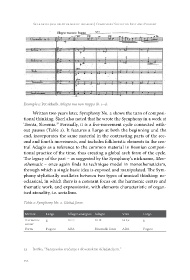
            Example 5: Pet skladb. Allegro ma non troppo (b. 1–4).

                 Written two years later, Symphony No. 2 shows the turn of composi-
            tional thinking. Škerl also noted that he wrote the Symphony in a week at
                             33
            Trenta, Slovenia.  Formally, it is a five-movement cycle connected with-
            out pauses (Table 2). It features a Largo at both the beginning and the
            end, incorporates the same material in the contrasting parts of the sec-
            ond and fourth movements, and includes folkloristic elements in the cen-
            tral Adagio as a reference to the common material in Bosnian composi-
            tional practice of the time, thus creating a global arch form of the cycle.
            The legacy of the past – as suggested by the Symphony’s nickname, Mon-
            othematic – once again finds its technique model in monothematicism,
            through which a single basic idea is exposed and manipulated. The Sym-
            phony stylistically oscillates between two types of musical thinking: ne-
            oclassical, in which there is a constant focus on the harmonic centre and
            thematic work, and expressionist, with elements characteristic of organ-
            ised atonality, i.e. serialism.


            Table 2: Symphony No. 2. Global form.

             Mvmnt     Largo     Allegro energico Adagio   Vivo      Largo
             Harmonic  g         In C:        In D:        In G:     g
             center
             Form      Fugato    ABA          Ritornelo form  ABA    Fugato


            33   Borko, “Sarajevsko srečanje s slovenskim skladateljem.”


            252

