


Page 28 - Studia Universitatis Hereditati, vol 13(1) (2025)
P. 28
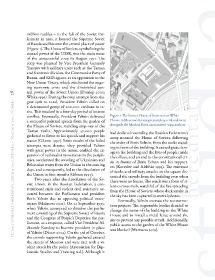
million roubles – to the fall of the Soviet Par-
               liament in 1993, it housed the Supreme Soviet
               of Russia and became the central place of power
               (Figure 1). The House of Soviets, symbolising the
               central power of the USSR, was the main scene
               of  the  unsuccessful  coup  in August 1991.  The
               coup  was  planned  by  Vice  President  Gennady
               Yanayev with military units such as the Taman
               and Kantemir division, the Communist Party of
               Russia, and KGB agents, as an opposition to the
               New Union Treaty, which reinforced the ongo-
               ing economic crisis and the diminished cen-
        28     tral power of the Soviet Union (Dunlop 2003;
               White 1992). During the coup attempt from Au-
               gust 19th to 22nd, President Yeltsin called on
        studia universitatis hereditati, letnik 13 (2025), številka 1 / volume 13 (2025), number 1
               a determined group of 200,000 civilians to re-
               sist. This resulted in a four-day period of intense
               conflict. Eventually, President Yeltsin delivered   Figure 1: The former House of Soviets, now White
               a successful political speech from the garden of   House, in Moscow’s Krasnopresnenskaya embankment
               the House of Soviets, standing atop one of the   alongside the Moskva River, axonometric view, authors.
               Taman  tanks.  Approximately  50,000  people   had declared neutrality, the Russian Federation’s
               gathered to listen to his speech and support his   army stormed the House of Soviets, following
               stance (Gibson 1997). Some results of the failed   the order of Boris Yeltsin, from the tanks stand-
               attempts were drastic: they provided Yeltsin   ing in front of the building. It caused great dam-
               with great power in the union, enabled the ex-  age to the building and the lives of people inside
               pansion of nationalist movements in the periph-  the offices, and an end to the constitutional cri-
               eries, accelerated the seceding of Ukrainian and   sis  in favour  of  Boris Yeltsin  and  his support-
               Belarusian states from the Union in the coming   ers (Koravlev and Alekhin 1993). The existence
               days, and consequently, led to the dissolution of   of tanks and military attacks on the square dis-
               the Union in four months (Gibson 1997).     tanced the crowds from the building even when
                   Two years after the dissolution of the So-  there were no fences. The result was a form of si-
               viet Union, in  the Russian Federation, a  con-  lent-curious mob, watchful of the fire spreading
               stitutional crisis and violent civil resistance oc-  from the House of Soviets, whose dark smoke in
               curred between the Parliament and president   the sky has been captured in several photos.
               Boris Yeltsin due to opposing political move-   Eventually, Yeltsin oversaw the reconstruc-
               ments (Malinova 2021). On 21 September 1993,   tion projects. The responsible bodies decided to
               when Yeltsin attempted to dissolve the parlia-  change the name of the building to the White
               ment consisting of the Supreme Soviet of Russia   House and to install a metal fence around the
               and the Congress of People’s Deputies, the par-  site to prevent any possible attack. Additionally,
               liament, as a response, called Vice President Al-  public access to the garden of the White House
               eksandr Rutskoy to become president in place   was blocked (Mamaeva 2019).
               of Yeltsin (Désert 2014). On the 3rd of October,
               the crowds supporting Yeltsin gathered around
               the streets of Moscow and were met with a vi-
               olent attack by the police (Association for Dip-
               lomatic Studies and Training n.d.). Although it

