


Page 31 - Studia Universitatis Hereditati, vol 13(1) (2025)
P. 31
The radical and massive demonstrations found
               echoes in the sessions of the parliament, conclud-
               ing with an acceptance of the students’ speech in
               the 17 October session, declaring their political
               demands for the government. After the decla-
               ration of independence in 1991, the capital city
               Kyiv and the parliament building underwent re-
               construction projects – the Soviet symbols on
               the facade removed, the interior decoration ren-
               ovated, the statues in the front replaced – to so-
               lidify the country’s decommunisation politics
               that continued until the destructive effects of
               the ongoing Russian-Ukrainian war.
                                                                                                           31
               Minsk and the Workers’ Rally – April 1991
               The Government House in Minsk and the for-
               mer Lenin Square in front of it, with a monu-
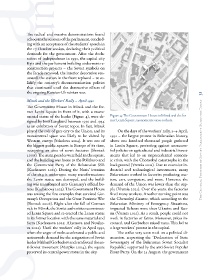
               mental statue of the leader (Figure 4), were de-  Figure 4: The Government House in Minsk and the for-
               signed by Iosif Langbard between 1930 and 1934   mer Lenin Square, axonometric view, authors.
               as an exhibition of Soviet topoi. In fact, Minsk
               played the role of gate city to the Union, and its   On the days of the workers’ rally, 3–4 April,
               monumental space was likely to be visited by   1991 – the largest protest in Belarusian history,
               Western envoys (Sokolova 2014). It was one of   above one hundred thousand people gathered
               the biggest public squares in Europe of its time,   in Lenin Square, protesting against unsuccess-
               occupying an area of seven hectares (Shostak   ful policies on agricultural and industrial invest- The Critical Position of Soviet Parliament Buildings Today
               2006). The main parades were held in the square,   ments that led to an unprecedented econom-
               and the building was home to the Politburo and   ic crisis, with the Chornobyl catastrophe in the
               the Communist Party of the Belarussian SSR   background (Vremia 2021). Due to excessive in-
               (Kachanova 2023). During the  Nazis’ invasion   dustrial and technological investments, many
               of the city, it underwent many transformations:   Belarusians worked in factories producing trac-
               the Lenin statue was destroyed, and the build-  tors, cars, computers, and more. However, the
               ing was transformed into Germany’s official bu-  demand of the Union was lower than the sup-
               reau (Kachanova 2023). The Government House   ply (Vremia 2021). Over the years, the factories
               was among the few examples that survived Ger-  fired many workers. Another turning point was
               many’s Occupation and the Great Patriotic War   the Chernobyl disaster, which according to the
               (Shostak 2006). Right after the fall of German   Belarusian Ministry of Emergency Situations,
               rule in Minsk, the Soviet authorities reconstruct-  impacted Belarus more than Ukraine and Rus-
               ed Lenin Square and re-erected the Lenin statue   sia (Vremia 2021). As a result, people could not
               in its former location with the same material and   work in factories or farms. Moreover, prices in-
               form (Kachanova 2023; Aksenova and Noviko-  creased, and Gorbachev raised taxes. This led to
               va 2022). Until the workers’ rally in April 1991,   a large workers’ protest in the capital.
               when the anger of mobs accelerated a public and   The strike very soon took on a political di-
               nationwide demand for the resignation of Soviet   mension, requesting the ‘Declaration of State
               leader Mikhail Gorbachev and reinforced the an-  Sovereignty of  the Belarusian  Soviet Socialist
               ti-Soviet movement (Marples 2004), the square   Republic’, supported by the anti-Soviet Popular
               preserved its central power status in the city.  Front Party. On the 25 August, the government

