


Page 29 - Studia Universitatis Hereditati, vol 13(1) (2025)
P. 29
Baku and the Protests Against Black January –
               January 1990
               The projects for the town planning of Baku,
               in a land rich in oil deposits, were drafted be-
               tween the 1920s and 1930s (Crawford 2022).
               During this period, the Soviet Union organ-
               ised architectural competitions to shape the ur-
               ban scene of Baku like a Soviet city. The former
               Soviet Palace – now called Government House
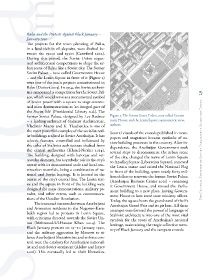
               – and the Lenin Square in front of it (Figure 2)
               were one of the main projects commissioned in
               Baku (Darieva 2015). In 1934, the Soviet authori-
               ties announced a competition for the Soviet Pal-                                            29
               ace, which would serve as a monumental symbol
               of Soviet power with a square to stage ceremo-
               nial mass demonstrations as ‘an integral part of
               the Soviet life’ (Presidential Library n.d.). The
               former Soviet Palace, designed by Lev Rudnev   Figure 2: The former Soviet Palace, now called Govern-
               – a leading architect of Stalinist Architecture,   ment House, and the Lenin Square, axonometric view,
               Vladimir  Munts  and  K.  Tkachenko,  is  one  of   authors.
               the most powerful examples of the socialist-real-  Several visuals of the crowds published in news-
               ist buildings realised in Soviet Azerbaijan. It has   papers and magazines became symbolic of na-
               eclectic features, controlled and influenced by   tion-building processes in the country. After in-
               the rules of Stalinist architecture drafted from   dependence, the Azerbaijan Government took
               the central authorities (Khmel-Nitskii 2014).   several steps to decommunise the urban scene  The Critical Position of Soviet Parliament Buildings Today
               The building, designed with baroque and ver-  of the city, changed the name of Lenin Square
               nacular elements, has a symbolic role in the city’s   to Azadlıq Square (Liberation Square), removed
               centre with its monumental scale and local con-  the  Lenin  statue  and  raised  the  National  Flag
               struction materials, being a combination of na-  in front of the building, spent nearly forty mil-
               tional and Soviet heritage. It is located in the   lion dollars to renovate the former Soviet Palace
               centre of the city’s coastal line. The Lenin stat-  (Azerbaijan Business Center 2010) – renaming
               ue and the square in front of the building were   it  Government House,  and  moved  the Parlia-
               designed for mass demonstrations, military pa-  ment building to a new place, leaving Govern-
               rades,  and  other  events,  such  as  commemora-  ment House to host some state ministry offices.
               tions of the October Revolution.            Today, the square hosts the grandstand of the F1
                   The increased tensions between Azerbaijani   Azerbaijan Grand Prix and its pit lane. All these
               and Armenian residents in the Nagorno-Kara-  attempts transformed the powerful language of
               bakh region led to protests in Lenin Square,   Stalinist architecture into one of the most vital
               with criticisms directed towards the Soviet Un-  symbols for the roots of Azerbaijan’s national
               ion (Mehmood-Ul-Hassan Khan 2014). The      heritage, maintaining the tragic collective mem-
               Black January protests on 19–20 January 1990,   ory of Black January and the rampant crowds.
               and the military aggression by Moscow to si-
               lence Azerbaijani liberationists and enforce con-
               trol, were the catalysts for Azerbaijani national-
               ist and anti-Soviet sentiment (Abilov and Isayev
               2016). This eventually led to their liberation.

