


Page 32 - Studia Universitatis Hereditati, vol 13(1) (2025)
P. 32
officially declared itself as an independent state
               (Korosteleva et al. 2003). With the dissolution
               of the Soviet Union, Minsk witnessed several
               steps in line with nation-building and decom-
               munisation politics (Korosteleva et al. 2003).
               The square, once known as Lenin Square, was
               renamed Independence Square, and the Soviet
               symbol was removed from the façade of the par-
               liament. However, the statue still stands, repre-
               senting the government’s identity politics, which
               emerged as a realignment with communist ideol-
               ogies, also known as ideological recycling (Bekus
        32     2017). The Belarusian government, by maintain-
               ing the Lenin statue in front of its parliament
               building, positions itself as the true inheritor of
        studia universitatis hereditati, letnik 13 (2025), številka 1 / volume 13 (2025), number 1
               Soviet heritage.
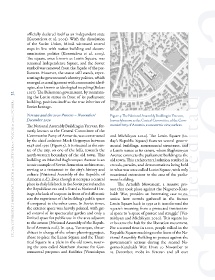
               Yerevan and the 2020 Protests – November/   Figure 5: The National Assembly Building in Yerevan,
               December 2020                               formerly known as the Central Committee of the Com-
               The National Assembly Building in Yerevan, for-  munist Party of Armenia, axonometric view, authors.
               merly known as the Central Committee of the
               Communist Party of Armenia, was constructed   and Michikyan 2020).  The Lenin Square  (to-
               by the chief architect Mark Grigoryan between   day’s Republic Square) features several govern-
               1948 and 1950 (Figure 5). It is situated at the cen-  mental  buildings,  monumental  structures,  and
               tre of the city, on one of the hills, towards the   a Lenin statue at its centre, where Baghramyan
               north-western boundary of the old town. This   Avenue connects the parliament building to the
               building on Marshal Baghramyan Avenue is an   old town. This architectural solution resulted in
               iconic example of Soviet Armenian architecture,   crowds, parades, and demonstrations being held
               serving as a testament to the city’s history and   in what was once called Lenin Square, with only
               culture (National Assembly of the Republic of   occasional extensions to the area of the parlia-
               Armenia n.d.). Even though it occupies a central   ment building.
               place in daily life both in the Soviet period and in   The Artsakh Movement, a massive pro-
               the Republican era and is listed as National Her-  test that took place against the Nagorno-Kara-
               itage, the lack of a square in front of it differenti-  bakh War, provides an interesting case to ex-
               ates the experience of the building’s public space   amine  how  crowds  gathered  in  the  former
               if compared to the other cases. In Soviet times,   Lenin Square back in 1991 as it transformed the
               the exterior space was heavily policed, with gat-  square’s meaning from a protected institution-
               ed control of its spectacular garden and only a   al space to ‘a space of protest and struggle’ (Ver-
               limited space for public use in the area adjacent   mishyan and Michikyan 2020). This square lat-
               to the avenue (National Assembly of the Repub-  er became the hub for the liberation movement.
               lic of Armenia n.d.). In 1924, Tamanyan, the ar-  For a second time in 2020, people rallied in the
               chitect in charge of the urban planning project,   Republic Square reaching to the front of the Na-
               chose to place the Lenin Square and the Theat-  tional Assembly Building to protest against the
               rical Square in a plain in the old town, reserv-  government’s actions during the second Na-
               ing the area called Northern Avenue for Gov-  gorno-Karabakh War. From 10 November to
               ernmental  purposes  and  facilities  (Vermishyan   25 December, mobs in Yerevan and all over

