


Page 128 - Studia Universitatis Hereditati, vol 13(2) (2025)
P. 128
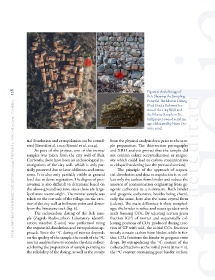
128                                                                    Figure 6: Aerial Image of
                                                                               Beli, Showing the Sampling
                                                                               Point for The Mortar Dating
        studia universitatis hereditati, letnik 13 (2025), številka 2 / volume 13 (2025), number 2
                                                                               (Red Dot), a Relevant Sec-
                                                                               tion of the City Wall, and
                                                                               the Mortar Sample in De-
                                                                               tail (project-owned aerial im-
                                                                               age, elaborated by Nives Do-
                                                                               neus, 2025)


               tial dissolution and extrapolation can be consid-  from the physical analysis done prior to the sam-
               ered (Sironić et al. 2023; Sironić et al. 2024).  ple preparation. The thin-section petrography
                   As part of the project, one of the mortar   and XRD analysis proved that the sample did
               samples was taken from the city wall of Beli.   not contain calcite recrystallization or magne-
               Currently, there have been no archaeological in-  site which could lead to carbon contamination
               vestigations of the city wall, which is only par-  or delayed hardening (see the protocol section).
               tially preserved due to later additions and exten-  The principle of the approach of sequen-
               sions. It is also only partially visible at ground   tial dissolution and data extrapolation is to col-
               level due to dense vegetation. The degree of pres-  lect only the carbon form binder and reduce the
               ervation is also difficult to determine based on   amount of contamination originating from ge-
               the above-ground sections, since these are large-  ogenic carbonate to a minimum. Both binder
               ly of more recent origin.  The mortar sample was   and geogenic carbonates, besides being chemi-
               taken on the east side of the village, on the exte-  cally the same, have also the same crystal form
               rior of the city wall at its lowest point and direct-  (calcite). The main difference is their morphol-
               ly on the limestone rock (fig. 6).          ogy; the binder is softer and reacts quicker with
                   The radiocarbon dating of the Beli sam-  acids forming CO2. By selecting certain grain
               ple (Zagreb Radiocarbon Laboratory identifi-  fraction (GF) of mortar and sequentially col-
               cation number Z-9011) was performed using   lecting portions of CO2 produced during reac-
               the sequential dissolution and extrapolation ap-  tion of GF with acid, the initial CO2 fractions
               proach. Since the  C dating of mortar depends   mostly contain carbon from binder, while in fur-
                               14
               on the quality of the sample, the result of the  C   ther CO2 fractions the binder to geogenic ratio
                                                     14
               mortar analysis have to consider the data collect-  drops. By extrapolating the  C content of the
                                                                                    14
               ed during the preparation of sample pointing to   collected fractions at the initial point (time = 0),
               the reliability of the dating, as well as the results   the  C content containing pure binder carbon,
                                                              14

