


Page 129 - Studia Universitatis Hereditati, vol 13(2) (2025)
P. 129
14
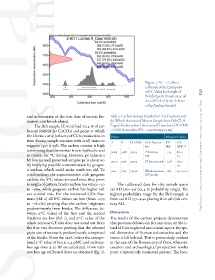
                                                                              Figure 7:  C – 1 Calibrat-
                                                                              ed Result of the Extrapolat-
                                                                              ed  C Value for Sample of    129
                                                                                14
                                                                              Beli (https://c14.arch.ox.ac.uk
                                                                              /oxcal/OxCal.html; elaborat-
                                                                              ed by Andreja Sironić)


               and information of the true date of mortar for-  Table 2: Carbon Isotope Results for CO2 Fractions and
               mation, can be calculated.                  the Whole Amount of Mortar Sample from Beli (Z, A –
                   The Beli sample (Z-9011) had 70.4 % of car-  Zagreb Radiocarbon Laboratory ID numbers, UGAMS
                                                                           13
               bonate content (as CaCO3) and point at which   – CAIS ID number, δ C – uncertainty 0.1 ‰)
               the kinetic curve (velocity of CO2 production in   Name                  Measured values
               time during sample reaction with acid) starts to   Z  A  UGAMS CO2 fraction   δ C   a C
                                                                                               14
                                                                                         13
               stagnate (pc) is 25%. The carbon content is high              size       (‰)   (pMC)
               confirming that the mortar is non-hydraulic and   9069  3768  75903  1  fraction,    –17.5  80.7 ±
                                                                              st
                           14
               so reliable for  C dating. However, pc value is a             6 %              0.3          The Roman Urbanisation of the Northern Adriatic Island of Cres
               bit low (at well preserved samples pc is about 60   9070  3769  75904  2  fraction 19 % –17.8  78.7 ±
                                                                              nd
               %) implying possible contamination by geogen-                                  0.3
               ic carbon, which could make result too old. To   9011  3723  75446  Whole amount  –18.0  75.1 ± 0.2
               confirm/deny the contamination with geogenic                  GF (100%)
               carbon, the δ C values are used since they point
                          13
               to origin of carbon, binder carbon has values –20   The calibrated date for this sample spans
               to –9‰, while geogenic carbon has higher val-  cal AD 260–535 (95.4 % probability range). The
               ues around 0‰. For the measured CO2 frac-   highest probability range for the Beli sample is
               tions (tbl. 2) all δ C values are low (from –17.5   from cal AD 337–440 placing it in 4th/5th cen-
                              13
               to –18.0‰) proving that the carbon originates   tury AD.
               predominantly from binder. The difference be-
               tween a C values of the first and the second   Discussion
                      14
               fractions are low (tbl. 1), and a C value of the   The results of the current projects demonstrate
                                          14
               whole amount GF also does not stand out from   that previous debates on Roman cities on the is-
               the first two fractions proving that the selected   land of Cres neglected one crucial aspect: the spa-
               grain size of mortar is predominantly comprised   tial dimension of Roman urbanisation and the
               of the binder. From the a14C values the extrapo-  traces it left behind. This is particularly evident
               lated a C value of 81.3 ± 0.4 pMC and radiocar-  in the case of the Roman city of Osor, where ex-
                     14
               bon age 1660 ± 30 BP are calculated. From radi-  cavation and archaeological prospection results
               ocarbon age calibrated dates are obtained (fig. 7).  paint a historically consistent picture. The loca-

