


Page 107 - Studia Universitatis Hereditati, vol 13(1) (2025)
P. 107
2
               strong befuddlement’  (cited in Pawlina 2023,
               172).
                   As per other fragments regarding this sub-
               ject in the  Serai Enderum,  Wojciech Bobo-
               wski only mentioned, before the passage above
               (Pawlina 2023, 122): ‘Odabaşı checks their [pag-
               es’] coffers. He opens them and looks for forbid-
               den herbs, coffee, tobacco and love letters.’
                   However, we must mention that Wojciech
               Bobowski  also  wrote  pharmaceutical  prescrip-
               tions on the marginalia of the London copy
               of  Mecmua-i Saz ü Söz (MS BL–Sloane 3114)
               which were studied by Burcu Şen Utsukarçi and                                               107
               Gökçe Toprak (2018).
                   For instance, in  Prescription 8, opium is
               mentioned among more than eleven drugs, prob-
               ably for rheumatic diseases (Şen-Utsukarçi and
               Toprak 2018, 199), but in Prescription 12 mikdar
               afyon (opium) was the only component and it
               was recommended against haemorrhoids. Wo-
               jciech Bobowski revealed, ‘In anal fissure bleed-
               ing, some opium paste is applied in the anus
               while the patient lies. Be patient with his pain.
               This process is repeated three times in succes-
               sion and the healing is soon observed’ (Şen-Ut-
               sukarçi and Toprak 2018, 204). There is still re-
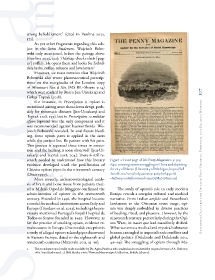
               search needed to understand how this literary   Figure 4: Front page of The Penny Magazine v. 9: 509,
               evidence  developed  until  the  proliferation  of   1840, covering opium smuggling in China and depicting  Exploring Cannabis and Opium in Post-Medieval Portugal and Related Nations
               Chinese opium pipes in the nineteenth century   the city of Macao (University of Michigan, https://hdl
               (Duco 1997).                                .handle.net/2027/mdp.39015013149631?urlappend
                   More recently, archaeotoxicological analy-  =%3Bseq=101%3Bownerid=13510798897178390-113)
               sis of brain and bone tissue from patients treat-
               ed at Milan’s Ospedale Maggiore confirmed the   The study of opium’s role in early modern
               administration of opiates in the seventeenth   Europe reveals a complex cultural and medical
               century. Founded in 1456, the hospital became   narrative. From Indian amfião and Paracelsus’s
               a model for medical institutions across Italy and   laudanum to the Ottoman court usage, opi-
               Europe (Giordano et al. 2023), including the pre-  um was deeply embedded in diverse practices
               viously mentioned Portugal’s Royal Hospital de   of healing, ritual, and pleasure. However, by the
               Todos-os-Santos founded in 1492. However, as   nineteenth century, particularly during the Opi-
               for the practice of smoking opium, evidence re-  um Wars, its status quo had manifestly shifted.
               mains scarce in Europe. One notable exception is   What was once a medical and mystical substance
               a study of alleged opium-related pipes discovered   became entangled in imperial trade conflicts and
               in Eastern Europe, dated to the eighteenth and   global politics (Delalande and Delalande 2011,
               nineteenth centuries (Mitrevski 2015, 35–36).  46–59). The smuggling of opium through Ma-
               2   This translation was kindly made available by Dr. Agata Pawlina who studied and translated the original version of A. Bobovio.
                   1665. Serai Enderum […]. (MS Harley 3409, Western Manuscripts Collection, British Library).

