


Page 113 - Studia Universitatis Hereditati, vol 13(2) (2025)
P. 113
decorative program, possibly conceived in em-
                                                           ulation of the sculptural scheme of the Forum
                                                                      9
                                                           of Augustus   – a model extensively replicated
                                                           throughout the Roman provinces. 10
                                                               Quite early was scholarly attention drawn
                                                           to a group of related statues that exhibit nota-
                                                           ble affinities with the Apsorus figure (Benndorf
                                                           1866, 230; Dütschke 1880, 324; Bulle 1894, 153),
                                                           namely the examples in Mantua (Palazzo Du-
                                                           cale, inv. no. 6674; Labus 1837, 258–9; Dütschke
                                                           1880, 323–5, no. 720; Collignon 1903, 22–4), the
                                                                                           11
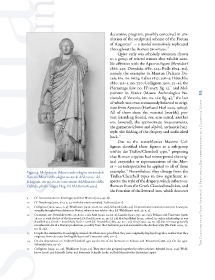
                                                           Hermitage (inv. no. ГР-3097; fig. 5),  and Mel-
                                                           pomene in Venice (Museo Archeologico Na-        113
                                                                                            12
                                                           zionale di Venezia, inv. no. 161; fig. 4),  the last
                                                           of which was even erroneously believed to origi-
                                                           nate from Apsorus (Harl and Harl 2025, 19809).
                                                           All of them share the material (marble), pos-
                                                           ture (standing frontal, one arm raised, another
                                                           one  lowered),  the  approximate  measurements,
                                                           the garments (chiton and diplex), archaistic hair-
                                                           style, the folding of the drapery and unfinished
                                                                13
                                                           back.
                                                               Due to the resemblances Maxime Col-
                                                           lignon classified these figures as a sub-group
                                                                                          14
                                                           within  the  Tralles/Cherchell type,   proposing
                                                           that Roman copyists had reinterpreted the orig-
                                                           inal  caryatides  as  representations  of  the  Mus-
                                                           es – an interpretation he applied to all of these
                                                                   15
               Figure 4: Melpomene (Museo archeologico nazionale di   examples.  Nevertheless, they diverge from the  The Caryatid from Osor (Apsorus): A Provincial Reinterpretation of a Classical Motif
               Venezia, Musei archeologici nazionali di Venezia e del-  Tralles/Cherchell types in two significant re-
               la Laguna,  inv. no. 161, su concessione del Ministero della   spects: the style of the drapery, which reflects in-
               Cultura; photo: Singer, Neg. D-DAI-Rom 68.4934)  fluences from the Greek Classical tradition, and
                                                           the function of the lowered arm, which does not
               9   Cf. reconstruction in Kreilinger and Atif Hamza (2019, 47–8).
               10   Cf. Boschung (2003, 6–7, n. 27, with the cited examples), La Rocca (2011).
               11   Collignon (1903, 24–5, n. 3), Waldhauer (1936, 26–8, no. 260), Schmidt (1982, 95). Its provenance remains uncertain; it was pre-
                   sumably brought from Athens to Venice, where it was sold in 1851 (cf. Waldhauer 1936, 26, n. 2).
               12   On statue, see: Dütschke (1882, 47–8, no. 120), Anti (1930, 29, no. 6), Lancha (1994, 995, no. 193), Polacco and Traversari (1988,
                   18, no. 2, with the list of the literature), De Paoli (2004, 71, no. II. 24) Harl and Harl (2025, 19809). In earlier scholarship, it was
                   classified as a Greek – most likely Attic – work (cf. Dütschke (1882, 47, no. 120), Anti (1930, 29, no. 6)), but it is now generally
                   considered to be of a Roman production, possibly from the Hadrianic period, executed in the Archaic style (De Paoli 2004, 71,
                   no. II. 24).
               13   Despite the similarities it was highly stressed that there is no proof that they were originally displayed together, neither that they
                   originate from the same finding (Polacco and Traversari 1988, 20–1).
               14   On the dependence on Tralles/Cherchell type see the list of the literature in Polacco and Traversari (1988, 20). On the type:
                   Schmidt (1982, 92–5).
               15   Collignon (1903, 22, 26), Waldhauer (1936, 27). They were also grouped together by other scholars: Mendel (1914, 259), Wald-
                   hauer (1936, 27), Schmidt (1982, 95). Evamaria Schmidt (1982, 95) held them for the Antonine copies.

