


Page 110 - Studia Universitatis Hereditati, vol 13(2) (2025)
P. 110
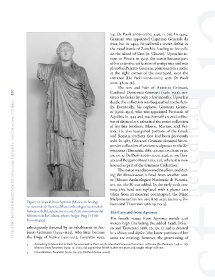
24; De Paoli 2006–2007, 446, n. 79). In 1494,
                                                           Grimani was appointed Capitano Generale da
                                                           Mar, but in 1499, he suffered a severe defeat in
                                                           the naval battle of Zonchio, leading to his exile
                                                                                        3
                                                           on the island of Cres (it. Cherso).  Upon his re-
                                                           turn to Venice in 1509, the statue became part
                                                           of his extensive collection of antiquities and was
                                                           placed in Palazzo Grimani, positioned in a niche
                                                           at the  right corner of the  courtyard, near the
                                                           entrance (De Paoli 2006–2007, 428; De Paoli
                                                           2021, 48, n. 16).
                                                               The son and heir of Antonio Grimani,
        110                                                Cardinal  Domenico Grimani (1461–1523), sur-
                                                           vived his father by only a few months. Upon his
                                                           death, the collection was bequeathed to the fam-
        studia universitatis hereditati, letnik 13 (2025), številka 2 / volume 13 (2025), number 2
                                                           ily. Eventually, his nephew, Giovanni Grima-
                                                           ni (1506–1593), who was appointed Patriarch of
                                                           Aquileia in 1545 and was himself an avid collec-
                                                           tor of classical art, inherited the entire collection
                                                           of his late brothers, Marco, Marino, and Vet-
                                                           tore. He also reacquired portions of the Greek
                                                           and Roman artefacts that had been previously
                                                           sold. In 1587, Giovanni Grimani donated his ex-
                                                           tensive collection of ancient sculptures to the Se-
                                                           renissima (Dütschke 1882, 46, no. 115; Anti 1930,
                                                           29, no. 5; De Paoli 2006–2007, 446, n. 79; Ferr-
                                                           ara and Bergamo Rossi 2021, 20), where it is now
                                                           housed as part of the Grimani Collection. 4
                                                               The statue was discovered headless, and dur-
                                                           ing the Renaissance, a head from another stat-
                                                           ue (Museo Archeologico Nazionale di Venezia,
                                                           inv. no. 162-B) was added. In the early 20th cen-
                                                           tury, this head was replaced with a plaster cast
                                                           taken from its museum counterpart, the Muse
                                                           Melpomene (inv. no. 161; Anti 1930, 29, no. 5; Po-
               Figure 1: Caryatid from Apsorus (Museo archeologi-  lacco and Traversari 1988, 19, no. 3).
               co nazionale di Venezia, Musei archeologici nazionali di
               Venezia e della Laguna, inv. no. 162-A, su concessione del   The Caryatid from Apsorus
               Ministero della Cultura; photo: Singer, Neg. D-DAI-
               Rom 68.4933)                                The female statue from Apsorus  stands 2.28
                                                           meters high (including the added head; Polac-
               subsequently donated by its inhabitants to An-  co and Traversari 1988, 19, no. 3) and is dressed
               tonio Grimani (1434–1523), who later became   in a chiton and diplex. The lower portions of her
               the Doge of Venice (1521–1523; Favaretto 1993,   arms are missing; however, the positioning of

               3   According to Marcella De Paoli, he remained in Osor on the island of Cres until his return to Venice (De Paoli 2021, 48, n. 16),
                   whereas Irene Favaretto (1993, 15; 2002, 84) argues that he left it after two years and sought refuge in Rome.
               4   On collection: Favaretto (2002, 84–93), De Paoli (2006–2007).

