


Page 114 - Studia Universitatis Hereditati, vol 13(2) (2025)
P. 114
ues do not feature holes in the head (Schmidt
                                                           1982, 95), and unlike the Tralles and Cherchell
                                                           figures their backs are left uncarved and with-
                                                           out elaboration – strongly indicating that they
                                                           were intended to be placed against a wall rather
                                                           than viewed in the round, and that they did not
                                                           play the supportive, but rather decorative role
                                                           (Schmidt 1982, 95, n. 548).
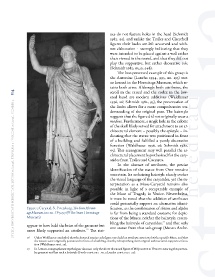
                                                               The best-preserved example of this group is
                                                           the Antonine (Lancha 1994, 995, no. 193) stat-
                                                           ue housed in the Hermitage Museum, which re-
                                                           tains both arms. Although both attributes, the
        114                                                scroll  in  the raised  and  the  codex  in the low-
                                                           ered hand are modern additions (Waldhauer
                                                           1936, 26; Schmidt 1982, 95), the preservation of
        studia universitatis hereditati, letnik 13 (2025), številka 2 / volume 13 (2025), number 2
                                                           the limbs allows for a more comprehensive un-
                                                           derstanding of the original pose. The hairstyle
                                                           suggests that the figure did not originally wear a
                                                           modius. Furthermore, a single hole in the calotte
                                                           of the skull likely served for attachment to an ar-
                                                           chitectural element – possibly the epistyle – in-
                                                           dicating that the statue was positioned in front
                                                           of a building and fulfilled a purely decorative
                                                           function (Waldhauer 1936, 26; Schmidt 1982,
                                                           95). This arrangement may well parallel the ar-
                                                           chitectural placement hypothesized for the cary-
                                                           atides from Tralles and Caesarea.
                                                               In the absence of attributes, the precise
                                                           identification of the statue from Osor remains
                                                           uncertain. Its archaizing hairstyle clearly evokes
                                                           the visual language of the caryatides, yet the in-
                                                           terpretation as a Muse-Caryatid remains also
                                                           possible in light of a comparable example of
                                                           the Muse of Tragedy in Venice. Nevertheless,
                                                           it must be noted that the addition of attributes
                                                           could potentially support an alternative identi-
               Figure 5: Caryatid, St. Petersburg, The State Hermit-  fication, as the combination of chiton and diplex
               age Museum, inv. no. ГР-3097 (©The State Hermitage   is far from being a standard costume for depic-
               Museum)                                     tions of the Muses, neither the hairstyle, resem-
                                                                                       17
                                                           bling the hairstyle of caryatides,  and that only
               appear to have held the brim of the garment but   one statue from that sub-group (Museo Arche-
                                               16
               more likely supported an attribute.  The stat-
               16   Oskar Waldhauer concluded that the lowered arm in each figure once held an attribute associated with a specific Muse, and that
                   the statues were originally positioned in front of a building, thereby relinquishing their original architectural, supportive func-
                   tion (Waldhauer 1936, 27).
               17  In Lexicon iconographicum mythologiae classicae, only the above discussed figure of Melpomene in Venice is wearing this particu-
                   lar garment and has such a hairstyle (Faedo 1994, 993–1011; Lancha 1994, 1013–25).

