


Page 143 - Studia Universitatis Hereditati, vol 13(2) (2025)
P. 143
wooden  beams  were  also  found,  most  likely
                                                           posts (palina) used for mooring ships in the har-
                                                           bour (Vrsalović 2011, 89). Along with the site in
                                                           Radiboj Bay, the Old Port was designated as one
                                                           of the most promising areas in the Osor waters,
                                                           with the intention of further systematic research
                                                           (fig. 2) (Vrsalović 2011, 89).
                                                               The category of isolated or individual ob-
                                                           jects also includes three partially preserved Ro-
                                                           man sculptures, discovered by chance by a
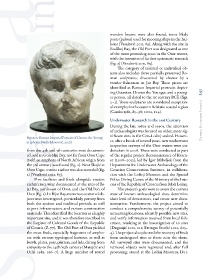
                                                           trawler fisherman in Jaz Bay. These pieces are
                                                           identified as Roman Imperial portraits depict-
                                                           ing Octavian, Drusus the Younger, and a young-  143
                                                           er person, all dated to the 1st century BCE (figs.
                                                           2–3). These sculptures are considered exception-
                                                           al examples in the eastern Adriatic coastal region
                                                           (Cambi 1982, 85–98; 2002, 124).

                                                           Underwater Research in the 21st Century         Zrinka Ettinger Starčić
                                                           During the late 1980s and 1990s, the attention
                                                           of archaeologists was focused on other, more sig-
               Figure 3: Roman Imperial Portrait of Drusus the Young-  nificant sites in the Cres-Lošinj seabed. Howev-
               er (photo: Nadir Mavrović, 2017)            er, after a break of several years, new underwater
                                                           inspection surveys of the Osor waters were un-
               from the 4th and 5th centuries were document-  dertaken in 2008. These were conducted as part
               ed, and in Golubljaj Bay, not far from Osor Cape   of the regular project Reconnaissance of Kvarn-
               itself, an amphora of North African origin from   er (2008–2012), led by Igor Miholjek from the
               the 3rd century was found (fig. 2). Near Škojić at   Department for Underwater Archaeology of the
               Osor Cape, a stone anchor was also recorded (fig.   Croatian Conservation Institute, in collabora-
               2) (Vrsalović 2011, 87).                    tion with the Lošinj Museum and the Special
                   Port facilities and finds alongside ancient   Police Diving Centre of the Ministry of the Inte-
               architecture were documented at the sites of Bi-  rior of the Republic of Croatia from Mali Lošinj.
               jar Bay, northwest of Osor, and the Old Port of   The project’s goals were to assess the current
               Osor (fig. 2). In Bijar Bay, numerous scattered ob-  state of known archaeological sites, determine
               jects were investigated, particularly pottery from   their level of devastation, and create new docu-
               both the ancient and medieval periods, as well   mentation. Furthermore, the project aimed to
               as port infrastructure and various construction   conduct a comprehensive survey of potentially
               materials. This identified the location as a highly   interesting locations, identify possible new sites,
               important site, and it was therefore inscribed in   and verify information received from local fish-
               the Register of Cultural Goods of the Republic   ermen, resulting in the investigation of 20 sites
               of Croatia (Z-77). The Old Port of Osor yielded   (Dugonjić 2010, 212; Ettinger Starčić 2012, 623–
               the most finds, especially fragments of ampho-  4). The project also planned the recovery of finds
               rae with various typological features, as well as   from endangered sites or those near the shore.
               bowls, plates, pots, platters, and lids, dating from   All surveyed sites were documented, and the
               antiquity to the 14th/15th century (Matejčić and   retrieved objects were registered and, after full
               Orlić 1982, 166–7). A large number of round   processing, stored at the Lošinj Museum. Dur-

