


Page 29 - Studia Universitatis Hereditati, vol 13(2) (2025)
P. 29
at the base of the core were deposited in rela-  Environmental Change in the Osor Bay Marine
               tively shallow water in proximity to the coast.   Sediments from Aprox. 5.5 cal ka BP (3500 BC)
               Although human occupation on island of Cres   to 1.5 cal BP (270–584 AD)
               is continuous since the Mesolithic (Forenbaher   The sediment core record in the interval between
               and Miracle 2005), the geochemical and sedi-  200–185 cm shows an abrupt change in sediment
               mentary record of core OSOR 2 does not im-  texture with a significant decrease in grain size
               ply any detectable environmental change that   to dominantly silt and a shift from primary ma-
               could be linked with human activities.      rine production of organic matter (C/N <10) to
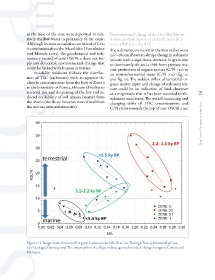
                   Insoluble residuum follows the distribu-  an  erosion/terrestrial  input  (C/N  >12)  (fig.  10
               tion of TIC (carbonate) with an upward de-  and fig. 11). The sudden influx of terrestrial or-
               cline in concentrations from the base of Zone 3   ganic matter input and change of sediment tex-
               to the boundary of Zone 2, this could be due to   ture could be an indication of land clearance
               sea-level rise and deepening of the bay and re-  at a magnitude that it has been recorded in the   29
               duced availability of soil mineral matter from   sediment succession. The overall increasing and
                                                                                                           Dip Your Finger in the Sea...
               the shores (the shore becomes more distal from   changing shifts of TOC concentrations and
               the marine accumulation site).              C/N ratios towards the top of core OSOR 2 are


               Figure 11: Changes in the Sources of Organic Carbon in the OSOR 2 Core Through Time (elaborated by Croa-
               tian Geological Survey, 2025). The arrows within the ellipse indicate general trends of change in organic Carbon and
               Nitrogen.

