


Page 96 - Studia Universitatis Hereditati, vol 13(2) (2025)
P. 96
tary camp in Croatia (Jadrić 2011, pl. 4, 2–4), the   strong colours and very high standards of crafts-
               early layers of Emona (Gaspari 2010, 110, fig. 64)   manship. Some of the colours, like emerald
               and Romula (Lazar 2025, 55), as well as from the   green, are the inventions of the newly established
               necropolis in Polhov Gradec (Lazar 2003, 37, fig.   Roman glass industry (Grose 1991, 2). The angu-
               9a) and Emona graves (Petru 1972, pl. 21, 17; Ple-  lar forms reveal the influence of the contempo-
               sničar Gec 1983, pl. 3, 12).                rary metalware of the Julio-Claudian era (Grose
                   The group of monochrome, translucent    1989, 254). The distribution of these products is
               coloured glasses from the early imperial peri-  Western; the majority of the examples were dis-
               od is represented by two mould-made vessels, a   covered on Italian and other European archaeo-
               plate and a bowl (fig. 2; 4), made of translucent   logical sites. That’s why this group is understood
               deep green glass. D. F. Grose defined six fami-  as a distinctive product of the early Roman glass
               lies of mould-made vessels within the group of   industry in the west, and the Italian production
        96     the  early  Roman  glass  (Grose  1989,  244–61).   centre is assumed. These glasses first appeared in
               Monochrome translucent coloured fine ware,   the first quarter of the 1st century AD, perhaps
               and monochrome opaque coloured fine ware,   continuing to about AD 60 (Grose 1989; 1991;
        studia universitatis hereditati, letnik 13 (2025), številka 2 / volume 13 (2025), number 2
               were defined as Family III – Roman cast mon-  2017). Only a generation or two after its appear-
               ochrome vessels (Grose 1989, 254). Due to the   ance, the coloured fine ware obviously fell from
               angular and carinated ceramic-like profiles,   fashion.
               the group was also known as the so-called glass   The plate and bowl from Osor (figs. 2–4)
               with ceramic profiles, as it was defined by Berg-  are made of deep green glass, typical of these
               er (1960, 24–30) in his study of the glass from   products. The most widespread colours are dark
               Vindonissa.                                 green in various shades, dark and cobalt blue and
                   This group of coloured fine wares was made   peacock blue, the result of the different miner-
               by mould pressing (Lierke 2009) and is charac-  als used to colour the glass. Emerald green and
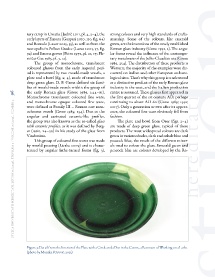
               terised by angular lathe-turned forms (fig. 3),   peacock blue are colours developed by the Ro-


               Figure 3: Detail from the Interior of the Plate with a Circle and a Dot in the Centre, a Remnant of Working on a Lathe
               (photo by Monika Petrović, 2025)

